

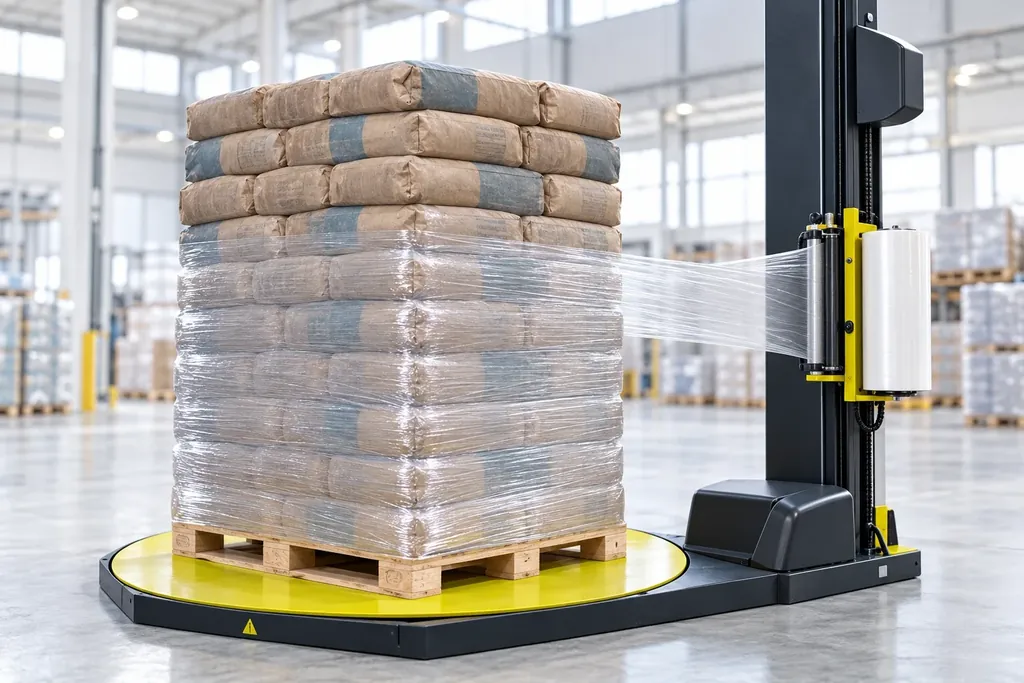
Short answer: in road transport, load securing must withstand forces equal to 80% of the load weight forwards and 50% sideways and backwards. This follows from Directive 2014/47/EU, the EN 12195-1 standard and the Polish regulation of 2018. The pallet wrapped in stretch film must also keep its shape. This is checked with the EUMOS 40509 test: the load unit passes when, under acceleration, its elastic deformation does not exceed 10% of its height and its permanent deformation does not exceed 5% of its height and 6 cm, with no damage to the goods.
Load stability on a pallet involves two separate tasks. The first is securing the pallet in the vehicle: straps, blocking, trailer walls. The second is the rigidity of the pallet itself: whether the goods will shift relative to the pallet or to each other when the driver brakes sharply. The second depends mainly on the stretch film and the wrapping method. Below we describe the regulations and standards that govern this, and what they mean for pallet wrapping. This article is for logistics, warehouse and packing managers at companies that ship many pallets a day.
The scale of the forces is greater than it seems: a pallet weighing 1,000 kg during emergency braking at 0.8 g pushes forwards with a force equivalent to a weight of about 800 kg. This force has to be taken by the straps and walls of the vehicle, and inside the pallet by the film, friction and the stacking pattern.
What forces must a load withstand in transport?
Acceleration values assumed for load securing in road transport:
| Direction | Force as a share of load weight | When it occurs |
|---|---|---|
| forwards | 0.8 g (80%) | emergency braking |
| backwards | 0.5 g (50%) | pulling away, reversing |
| sideways | 0.5 g (50%) | cornering, lane changes |
| sideways, load prone to tipping | 0.6 g (60%) | cornering with a high centre of gravity |
These values are given in Directive 2014/47/EU (Annex III) and the EN 12195-1 standard. In Poland they are implemented by the Regulation of the Minister of Infrastructure of 25 January 2018 on the method of carrying loads (Journal of Laws 2018 item 361). Its § 4 requires that, for trucks and trailers, securing must withstand 80% of the load weight in the direction of travel and 50% sideways and backwards. The regulation also requires the securing method to be chosen taking into account the properties of the load and its packaging (§ 6).
During a roadside inspection, the inspector may also treat it as a defect if the transport packaging does not allow the load to be secured properly. A pallet that falls apart under the straps is therefore a legal problem, not just a complaint issue.
What is the EUMOS 40509 test?
EUMOS 40509 is a European test method for the rigidity of a load unit, i.e. a pallet together with the goods and the film. The current edition dates from 2020. The test answers the question of whether a wrapped pallet will keep its shape under the forces that occur in transport.
How the test works:
- The pallet is placed on a platform that accelerates or brakes sharply.
- The acceleration builds up in less than 50 ms and is held for at least 300 ms, usually at 0.5 g, and at 0.8 g in the version for the direction of travel.
- High-speed cameras record how far the pallet tilts during the test and how much displacement remains after it.
Pass criteria according to the European cargo securing guidelines:
| Criterion | Threshold |
|---|---|
| elastic deformation during the test | less than 10% of the unit height |
| permanent deformation after the test | less than 5% of the unit height and less than 6 cm |
| condition of goods and packaging | no permanent deformation or damage |
A pallet 1.6 m high passes the test if it tilts less than 16 cm during the test and is displaced less than 6 cm after the test (5% of the height would give 8 cm, but the lower of the two thresholds applies).
A simpler test: the tilt test
The European Commission guidelines also allow a tilt test. The pallet is placed on a platform that is tilted to a set angle. A tilt of 26.6° corresponds to a force of 0.5 g, and 38.7° to a force of 0.8 g (the tangent of the angle corresponds to the acceleration). The guidelines state that any method of binding the goods to the pallet, including stretch film, is sufficient if the pallet withstands a sideways tilt of at least 26.6° without significant deformation.
This test can be carried out without a specialised platform and is well suited to comparing two ways of wrapping the same pallet.
Is the EUMOS 40509 test mandatory?
No. The regulations require effective load securing, but they do not require EUMOS certification for a pallet. The test is a way to demonstrate it. The European guidelines stress that pallet rigidity cannot be assessed visually or calculated from film parameters, which is why they recommend type testing for repeatable load units.
The test result also has practical value. According to the guidelines, pallets with consumer goods can be transported without straps, resting against the walls and curtain of the vehicle, if the unit withstands 0.5 g in all directions, the goods do not puncture the film, and the total gap across the width of the vehicle does not exceed 15 cm.
A European standard, EN 17321, is in preparation and is to introduce transport stability levels (TSL) from 0.18 g to over 1.0 g. Until it is published, EUMOS 40509 remains the reference point.
How does a pallet lose stability?
The guidelines describe several ways in which a wrapped pallet fails in transport:
- the whole load slides off the pallet when the film does not connect the bottom layer of goods to the pallet,
- layers shift relative to each other when there is low friction between them, for example smooth cardboard,
- the top layer lifts and tilts,
- goods tilt within a layer,
- the pallet "breaks" into two parts at the height where the film holds weakest.
Each of these cases needs a different fix. Sliding off the pallet is fixed by stronger wrapping of the bottom zone and connecting the film to the pallet. Layer shifting is fixed by anti-slip sheets, because ordinary cardboard increases the risk of slipping. Stretch film can hardly prevent slipping when friction between layers is very low or when the goods are smaller than the pallet.
How to build a stable pallet before wrapping?
Film stabilises what is already well stacked. Before the pallet goes onto the stretch wrapper, check:
- technical condition of the pallet: cracked boards, protruding nails and a deformed pallet weaken the whole unit, and film will not make up for it,
- weight distribution: the heaviest packages at the bottom, lighter ones at the top, the centre of gravity as low as possible and as close to the centre of the pallet as possible,
- stacking pattern: an interlocked pattern, in which successive layers overlap like bricks in a wall, binds the layers more strongly than a column pattern,
- pallet footprint: goods should not overhang the pallet edges, and a load smaller than the pallet is harder to secure with film,
- friction between layers: anti-slip sheets increase friction, while ordinary cardboard sheets between smooth cartons can reduce it,
- edges: corner protectors and edge boards protect carton edges from film pressure and stiffen the vertical edges of the unit,
- heavy load: for heavy or irregular loads, the film is supplemented with strapping.
What in the wrapping determines load stability?
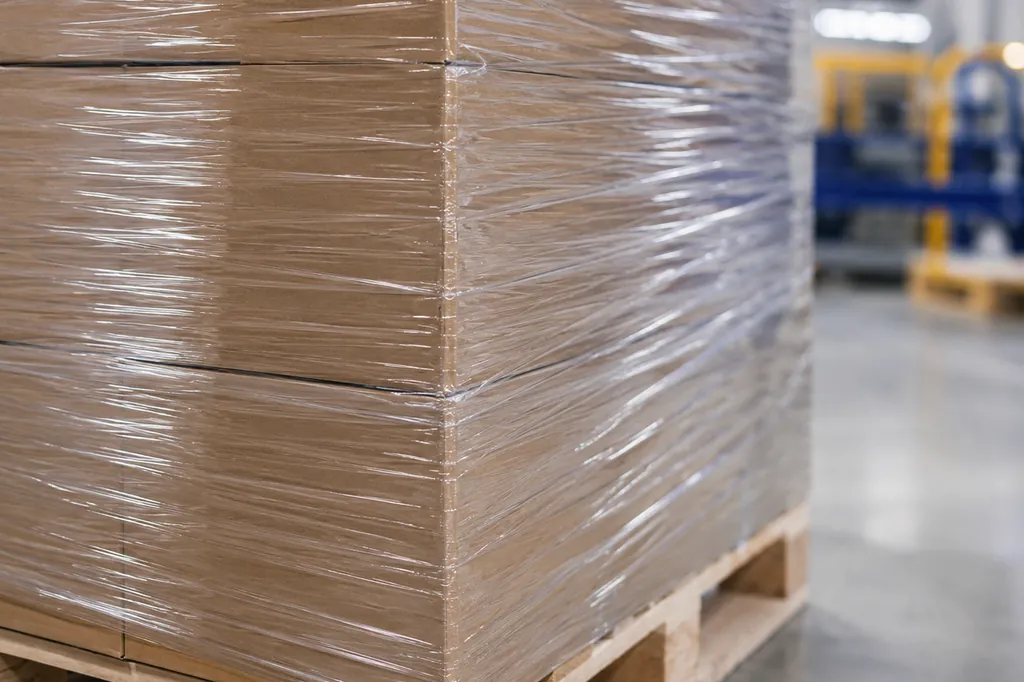
Pallet rigidity is determined by the force with which the film compresses the load (containment force) and its distribution over the height of the pallet. It is affected by:
- film stretch on the stretch wrapper: the higher the pre-stretch, the more tightly the film compresses the load, but only up to the film's strength limit,
- number of wraps in each zone: bottom, middle and top,
- bottom wrap connecting the goods to the pallet: this is the zone where the load most often slides,
- film type: films with a higher working stretch, such as the five-layer Power (220-350%), give more containment force from the same film weight,
- film thickness matched to the edges of the goods, so that the film does not wear through at the corners.
The stretch wrapper manufacturer Lantech gives indicative containment force values depending on the type of load, from a few pounds for light loads to over ten for unstable ones, and recommends measuring it in three zones of the pallet and taking the lowest reading. Containment force is measured with an instrument, not by touch.
A 2021 study by the Warsaw University of Technology showed how much the wrapping programme itself matters: the same pallet passed the test at 0.4 g with one setting, and tilted too far at 0.5 g. A different choice of film and number of wraps changed the result.
We write about how stretch translates into film consumption in the article Stretch film thickness.
How we check wrapping at the customer's site
Pallet stability cannot be chosen from behind a desk. As part of a free packaging audit, our technologist measures film consumption per pallet, the actual stretch on the stretch wrapper and the wrapping time at the customer's site, tests film variants and sends a report with the recommended variant within 5 days. You then check the chosen film with a test batch on your own stretch wrapper.
You will find details on the packaging audit page, and the film parameters in the stretch film table.
Frequently asked questions about pallet load stability
What forces must load securing withstand?
80% of the load weight forwards and 50% sideways and backwards, and 60% sideways for a load prone to tipping. This is set out in Directive 2014/47/EU, the EN 12195-1 standard and the regulation published in Journal of Laws 2018 item 361.
What is the EUMOS 40509 test?
It is a test method for the rigidity of a pallet with goods. The pallet on a platform undergoes a sharp acceleration, usually 0.5 g. It passes the test if the elastic deformation is less than 10% of its height and the permanent deformation is less than 5% of its height and 6 cm.
Is EUMOS 40509 certification mandatory?
No. The regulations require effective load securing, and the EUMOS 40509 test is a recognised way to demonstrate it.
Is stretch film alone enough to secure a pallet?
The film is responsible for pallet rigidity, i.e. for making sure the goods do not shift relative to the pallet. The pallet in the vehicle must also be secured with straps or blocking, unless the unit withstands 0.5 g and meets the conditions for transport without straps set out in the EU guidelines.
How to check pallet stability without a laboratory?
With the tilt test: a pallet that withstands a sideways tilt of 26.6° without significant deformation corresponds to a force of 0.5 g.

About the author
Łukasz Zębala
Production technologist, Dominopack
Every day he sets the parameters of our production and knows packaging machines from the settings side. He selects machine film, Power film and technical cores. During the free packaging audit he comes to your hall with scales, a micrometer and a stopwatch and watches packaging with the stretch wrapper running.
Sources
- Directive 2014/47/EU, Annex III (cargo securing)
- European Best Practice Guidelines on Cargo Securing for Road Transport, European Commission, 2014, ISBN 978-92-79-43643-7
- Regulation of the Minister of Infrastructure of 25.01.2018 on the method of carrying loads, Journal of Laws 2018 item 361
- EN 12195-1 Load restraining on road vehicles - Safety - Calculation of securing forces
- EUMOS 40509:2020 Test method for load unit rigidity
- Tkaczyk et al., Sensors 2021, 21(15), 5129, doi:10.3390/s21155129
- Lantech, How to figure out the right containment force for your loads, lantech.com
- Dominopack data: packaging audit and Power film, dominopack.pl, as of November 2026