

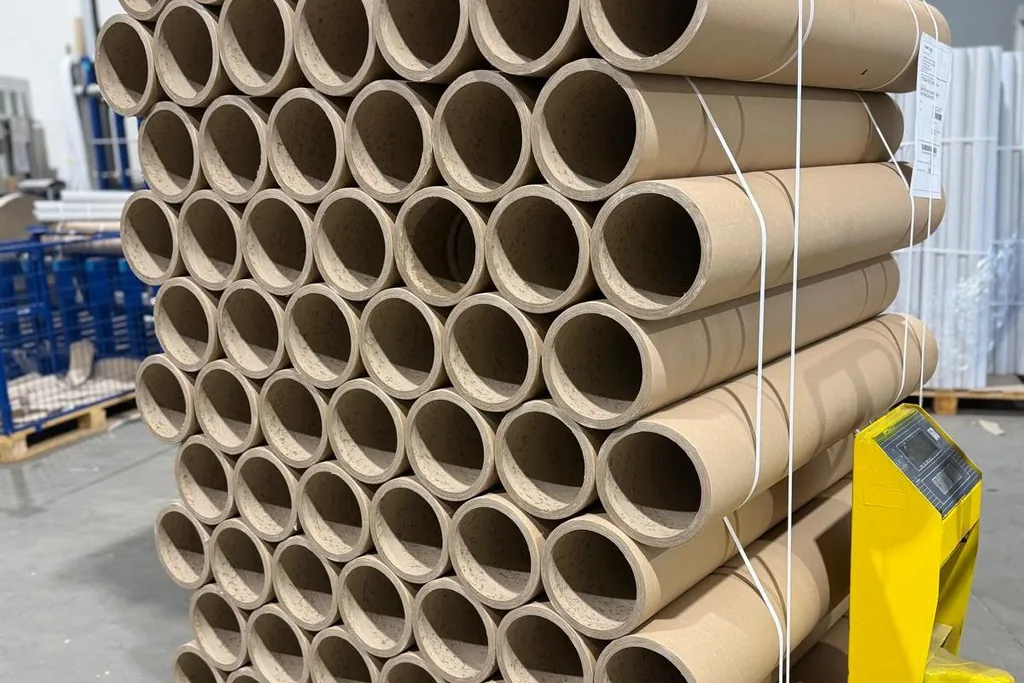
Short answer: the strength of a paper core is described by several tests from the ISO 11093 series of standards. The most commonly quoted is flat crush resistance (ISO 11093-9), measured on a 100 mm long sample and expressed in kN/m. A full specification also includes the inside diameter tolerance (ISO 13542), straightness and ovality (ISO 11093-5) and moisture content (ISO 11093-3). A result only means something together with the test conditions, so when comparing offers, ask about the method, not just the number.
Paper cores, also called cardboard cores, board cores or cardboard tubes, are cores wound from many layers of strong board and adhesive. They are used for winding various materials: film, paper, tapes, fabrics, nonwovens and membranes. Requests for quotation most often mention two numbers: inside diameter and wall thickness. Yet only test results tell you whether a core will withstand the roll, transport and storage. As a manufacturer of cardboard cores and stretch film, we test them in every batch. Below we explain how to read these results. This article is for purchasing departments, technologists and production managers who order cores for winding on their own lines.
Where are paper cores used and which parameter is critical?
Cardboard cores are widely used in many industries, but in each of them a different parameter decides the choice. From our table and our experience with core selection:
| Application | Typical inside diameter | Critical parameter |
|---|---|---|
| food films, labels | ∅28-40 mm | diameter accuracy, food contact certificate |
| hand stretch film | ∅38 mm | core weight (it ends up in the operator's hand), crush resistance |
| machine stretch film, printing | ∅50-76 mm | crush resistance, fit to the stretch wrapper mandrel |
| tapes, laminates, technical films | ∅40-45 mm | roundness and straightness |
| paper mills, textile industry | ∅100 mm | bending stiffness for long cores |
| geotextiles, floor coverings | ∅150 mm | crush resistance under a heavy roll |
| heavy rolls, cables and steel coils | ∅250 mm | crush resistance up to 15.2 kN, wall thickness up to 15 mm |
In the packaging industry, crush resistance and core weight count most. In the paper and textile industries, where cores are up to 3200 mm long, bending stiffness and straightness are added. That is why the same parameters are not enough for all applications: the specification has to be written for the specific application.
Which standards describe paper core testing?
Core testing is described in the ISO 11093 series "Paper and board - Testing of cores". Each part covers a different parameter:
| Part of the standard | What it measures | When it matters |
|---|---|---|
| ISO 11093-1 | sampling | so that the result applies to the whole batch, not a selected piece |
| ISO 11093-2 | conditioning of samples before testing | results from different laboratories are only comparable under the same climate |
| ISO 11093-3 | moisture content by the drying method | cardboard changes its strength and dimensions with moisture content |
| ISO 11093-4 | dimensions: inside and outside diameter, wall, length | fit to the shaft, mandrel and material width |
| ISO 11093-5 | roundness and straightness | core run-out on the shaft during high-speed winding |
| ISO 11093-6 and 7 | bending strength and modulus of elasticity (three-point method) | long cores supported at the ends, deflection on the shaft |
| ISO 11093-8 | natural vibration frequency | critical speed on high-speed lines |
| ISO 11093-9 | flat crush resistance | the basic measure of core strength |
| ISO 11093-10 | axial crush | pressure along the core axis |
Inside diameter tolerances are described by a separate standard, ISO 13542. Most manufacturers do not test all parameters in every batch. In the specification it is enough to choose those on which the core's performance at the customer's site depends.
What does core crush resistance mean?
Flat crush resistance is the force at which a core compressed between two parallel plates loses its shape. According to ISO 11093-9, a 100 mm long sample is tested (for cores with an inside diameter of up to 300 mm), cut at least 100 mm from the end of the core. The press plates close at a speed of 50-65 mm/min, and the result is read at the first force peak on the graph.
The standard gives the result in kN/m, i.e. per metre of core length. Many manufacturers, including us, state the force measured on the 100 mm sample itself. The conversion is simple: the result for a 100 mm sample is multiplied by 10.
| inner ∅ | Wall | Result on a 100 mm sample | The same result in kN/m |
|---|---|---|---|
| ∅38 mm | 2-4 mm | 1.9 kN | 19 kN/m |
| ∅76 mm | 4-10 mm | 6.1 kN | 61 kN/m |
| ∅150 mm | 6-15 mm | 11.7 kN | 117 kN/m |
| ∅250 mm | 8-15 mm | 15.2 kN | 152 kN/m |
Values from our core table, for the middle wall thickness of the range, as of November 2026.
This is a frequent cause of misunderstandings when comparing offers. A core described as "6 kN" and a core described as "60 kN/m" may be exactly as strong. That is why in an enquiry it is worth asking for the result in kN/m or for information on the sample length it was measured on.
Flat crush, radial crush and axial crush: how do they differ?
- Flat crush compresses the core from two sides. It is the standard industry test and the most common parameter in specifications.
- Radial crush presses the core evenly around its whole circumference, usually with a pneumatic cushion. It better reflects the pressure of the roll, especially film that shrinks after winding and squeezes the core.
- Axial crush acts along the axis of the core (ISO 11093-10). It matters when pressure is applied to the end face of the core.
The results of these tests cannot be converted into one another. If your material supplier or your roll customer requires a specific test, name it in the specification.
What does the strength of a paper core depend on?
Strength depends on the diameter, wall thickness, paper grammage and type, the adhesive and moisture content. Wall thickness alone says little about it. An example from our tests, a ∅76 × 600 mm core: an 8 mm wall made of mixed waste paper withstood 5.2 kN, while a 6 mm wall made of recycled board withstood 6.1 kN. The thinner core was stronger, because the material changed.
With the same crush resistance, a core can weigh up to 20% less if the paper and adhesive are chosen correctly instead of thickening the wall.
That is why it is better to state the required crush resistance in kN in the specification rather than a minimum wall thickness. The manufacturer then has room to choose a lighter core with the same strength.
How does moisture affect cores?
Cardboard absorbs moisture from the air. As its moisture content rises, its strength falls and the dimensions of the core change. There is no public numerical data for cores alone, but studies of cardboard show the scale of the effect: a change in air humidity of 10 percentage points changes the compression strength of cardboard by about 10%, and boxes stored at 80% relative humidity lose 27-32% of their compression strength.
This leads to three practical rules:
- A test result is only comparable when the samples were conditioned in the same way (ISO 11093-2). Results from different laboratories are hard to compare without information on the climate.
- It is worth measuring moisture content in every batch (ISO 11093-3), because it determines whether the core in your hall will have the strength stated in the data sheet.
- When choosing a core, what counts is the climate of the hall where the winder works and of the warehouse where the rolls are stored. A core chosen with no margin in a dry hall may not be enough in a humid warehouse.
Which dimensional tolerances are standard?
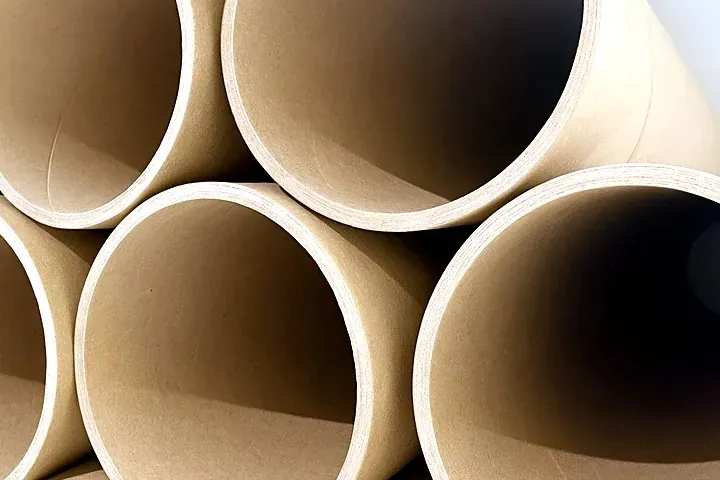
The inside diameter determines whether the core sits securely on the shaft, mandrel or chucks of the machine. ISO 13542 specifies one-sided tolerances, i.e. upwards only:
| Inner diameter | Tolerance according to ISO 13542 |
|---|---|
| 10-60 mm | +0.5 mm |
| 76 mm | +1.2 mm |
| 100 mm | +1.4 mm |
| 150 mm | +1.6 mm |
| 200 mm | +2.0 mm |
| 250 mm | +2.5 mm |
The same standard allows ovality, i.e. the difference between two perpendicular inside diameters, of up to 0.5 mm for diameters below 70 mm and up to 1.5 mm for diameters of 70 mm and above.
We cut the core to the required length with a tolerance of ±1 mm, up to a length of 3200 mm. We test straightness along the whole length of the core, because a bent core runs out on the shaft and, with wide rolls, pulls the material to one side.
Spiral and parallel cores
Paper cores are produced with two web arrangements:
- spiral: the webs are wound at an angle, so the core can be cut to practically any length. This is the most common type of core for film, paper and tapes.
- parallel (convolute): the web runs parallel to the axis. Such cores have higher bending stiffness, but their length is limited by the web width.
They also differ in the way they fail: a spiral core splits along the spiral seam, while a parallel core buckles and wrinkles. For most film and paper rolls, a spiral core with a correctly chosen wall meets the requirements.
How to prepare a specification for paper cores?
A specification that allows a core manufacturer to prepare an offer without further questions includes:
- inside diameter and the type of shaft, mandrel or chucks the core will be mounted on,
- length of the core and the permitted tolerance,
- required crush resistance in kN/m, or in kN together with the sample length,
- roll weight and width and winding speed,
- method of transport and storage: number of layers, time, warehouse conditions,
- food contact, if the core goes into food packaging (our ∅28-50 mm cores have a hygiene certificate, larger diameters on request),
- required tests and documents for each batch.
We test every batch of cores before shipment: crush resistance on a press, on a 100 mm sample, as the average of 10 measurements, plus straightness and moisture content. You receive the results in writing together with the test batch. We write more about choosing cores for heavy rolls in the article Cardboard cores for technical films.
Frequently asked questions about paper core strength
In what unit is core strength given?
The ISO 11093-9 standard gives flat crush resistance in kN/m. Manufacturers often state the force measured on a 100 mm sample in kN or in N. The result for a 100 mm sample is multiplied by 10 to get kN/m.
Does a thicker wall mean a stronger core?
Not always. Strength also depends on the paper, the adhesive and moisture content. In our tests a ∅76 mm core with a 6 mm wall withstood 6.1 kN, while one with an 8 mm wall made of a different material withstood 5.2 kN.
Which core for stretch film?
For hand film the standard is ∅38 mm with a 2-4 mm wall, for machine film ∅50 mm, and for heavier rolls ∅76 mm with a 4-10 mm wall. The diameter is matched to the stretch wrapper mandrel, and the wall to the roll weight.
What are the largest paper cores you produce?
Cores with an inside diameter of up to 250 mm, a wall of up to 15 mm and a length of up to 3200 mm. They withstand up to 15.2 kN on a 100 mm sample, i.e. 152 kN/m.
How long does it take to introduce a new core dimension?
First we choose the parameters and send a test batch. Once it is approved, we deliver the series order within 10 days.

About the author
Monika Jeziorowska
Cardboard core adviser, Dominopack
She handles cardboard core sales. She works with customers to choose the core diameter, wall and crush resistance for their roll, prepares the quote and provides the parameters in writing.
Sources
- ISO 11093-9:2019 Paper and board - Testing of cores - Part 9: Determination of flat crush resistance, iso.org/standard/91607.html (method described according to the 2006 edition)
- ISO 11093-5:2016 Determination of run-out, iso.org
- ISO 13542:2006 Paper and board - Cores - Tolerances on inside diameter, iso.org/standard/36633.html
- ISO 11093-4:2022 Measurement of dimensions, iso.org/standard/77831.html
- Georgia Tech, Effects of moisture content on box compression strength, research.gatech.edu
- Dominopack data: cardboard core parameter table, dominopack.pl/tuleje-tekturowe.html, as of November 2026